
Living Music:
A NOTEWORTHY LEGACY
By Amy Lynch
Where many simply hear sound, Paul Winter Northwestern ’58 hears music.
The celebrated saxophonist, composer and bandleader leads the Paul Winter Consort and Living Music Records, marrying instruments and improvisation with the sounds of nature to create a genre he refers to as “Earth Music.”
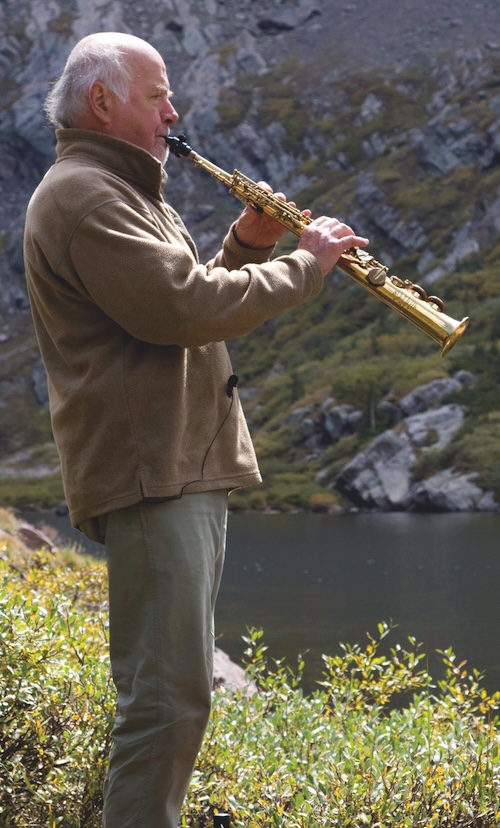 Born and raised in Altoona, Pennsylvania, Winter’s fascination with music emerged early on, taking on drums at age 5, piano at 6, clarinet at 7 and saxophone at 9. Winter played in small bands with schoolmates and, by age 17, was touring Midwestern state fairs with a professional pit orchestra for a show called “Westorama.”
Although Winter said music was an important part of his youth, he never seriously considered it a future career.
“My family was always supportive, but [music] wasn’t something one would do for a living,” he said. “We were expected to do something responsible. I had no idea what that might be when I finished high school.”
In considering colleges, Winter was familiar with Northwestern University in Evanston, Illinois, because his older sister was already studying there, and nearby Chicago’s deep jazz culture sealed the deal. But still, he decided not to pursue a music degree during his years on campus from 1957 to 1961.
“I had no interest in the European classical traditions they taught in music school,” he explained. “I majored in general confusion until my senior year when I had to declare something. I chose English composition mainly because of a great literary professor there named Bergen Evans.”
Although it wasn’t his major, music led Winter to Phi Kappa Psi in a roundabout way.
“I pledged Phi Psi thanks to George Riseborough Northwestern ’55, a wonderful trumpet player who had been part of the state fair band with me during the summer of 1957,” he recalled. “He was already a senior and took me under his wing, guided me through Rush Week and encouraged me to join the Fraternity.”
Becoming part of the musical community through campus and local connections, Winter organized a dance band his freshman year that performed around the North Shore and in the city. The group evolved into a sextet his senior year, earning first-place honors at the 1961 Intercollegiate Jazz Festival at Georgetown University in Washington, D.C., and snagging a recording contract with Columbia Records.
“I had long been interested in the State Department’s Jazz Ambassadors cultural exchange program, and I wrote to them suggesting they consider sending us on a goodwill tour of universities in the Iron Curtain countries,” Winter said. “It happened that our sextet was perfectly integrated — three blacks, three whites — at this time, early in the Kennedy years, when Civil Rights was a major issue.”
After reviewing their audition tape, the State Department decided to dispatch the band on a six-month tour of 23 Latin American countries instead.
“It changed our lives, and showed me a path on which music, I felt, could make a contribution to the world,” Winter said.
It also caught the attention of Jackie Kennedy. At the First Lady’s invitation, Winter and his bandmates performed in the East Room on Nov. 19, 1962. It was the first ever jazz concert held at the White House.
Since the formation of the Paul Winter Consort in 1967, the prolific musician has traveled the world for performances and musical research expeditions that have taken him to 52 countries across six continents, including those Iron Curtain regions he’d hoped to visit back in the 1960s.
“I borrowed the name ‘consort’ from the ensembles of Shakespeare’s time, the house bands of the Elizabethan Theater, which adventurously blended woodwinds, strings and percussion — the same families of instruments I wanted to combine in our contemporary consort,” Winter points out.
His ability to merge elements of jazz, bossa nova beats and nature sounds solidly established Winter as a forefather of world music and gave him the heart of an environmental activist. Of the 50 albums he’s recorded, many of which are on the Living Music label he launched in 1980, seven have won Grammy Awards.
Winter’s primary performing forum for many years has been an extraordinary acoustic space — New York’s St. John the Divine Cathedral, the world’s largest. He and the Consort have been artists-in-residence there since 1980 and have presented more than 200 secular musical events.
Now in his 80s, Winter continues to tour the world with the Consort and actively supports organizations that work to preserve biological and cultural diversity. Throughout his journey, he’s worked to create timeless music that celebrates the creatures and cultures of the Earth.
“I hope that this legacy of ‘Living Music’ will continue to inspire future generations of musicians and listeners,” he said.
For more information or to hear Winter’s music, go to paulwinter.com.